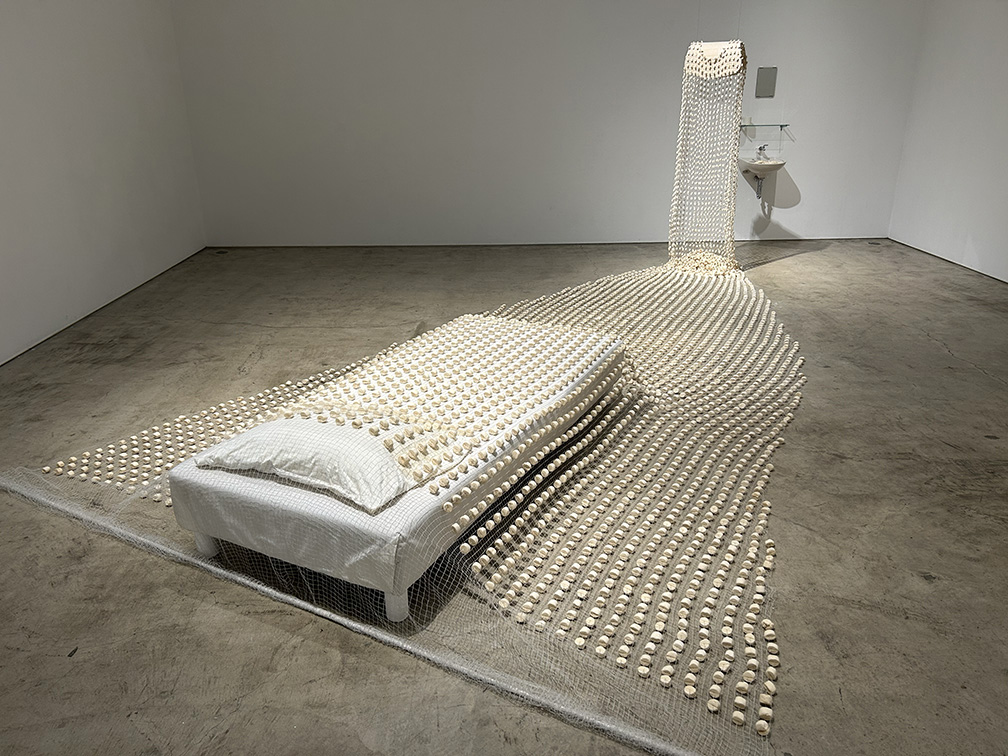
Internal Dress, Internal Quilt
1999-2000
fowling net, marshmallows, bed, pillow, washbasin, mirror
Takahashi Ryutaro Collection
Internal Dress, Internal Quilt is the central work of Trace the Skin project, which reconsiders the boundaries and identity of the self. The body portion consists of 2,000 marshmallows, while the hem consists of approximately 6,000 marshmallows; according to the artist, these numbers correspond respectively to the unfolded surface areas of the rectum and the small intestine. Even artificial sugary confections, unlike natural foods such as meat and vegetables, are absorbed through the digestive tract and become part of the body. Conversely, hair and nails, once part of oneself, are cut away, discarded as waste, and eventually turned to smoke. All constituents of the material world are interconnected as a networked system. This work regards the inner wall of the digestive tract—the site where food passing through the body is actually absorbed—as a second skin and visualizes it in the form of clothing.
The work was produced over a four-day period beginning on September 30, 1999, in Studio B of Framework Gallery in Kotake-Mukaihara, Tokyo. It was presented as an open studio on October 4, and photographed by KUROKAWA Mikio with a male foreign model wearing the garment.
The work was subsequently exhibited, together with works from the project that had previously been developed under the title Rabbit Project, in the solo exhibition floating body held at TEPCO Ginza-kan Plus Minus Gallery (January 4–February 29, 2000), which had supported the production of this work.
The bed, pillow, washbasin, and mirror were added when the work was exhibited in the solo exhibition Trace the Skin at Mizuma Art Gallery, then located in Aoyama, Tokyo (April 4–28, 2000). In the exhibition checklist, Internal Quilt—which covered the bed and pillow and was accompanied by the statement “The surface area of the finger-like projections of the small intestine, each measuring one millimeter, is twenty times that of the entire body's surface area”—and Internal Dress—which faced the washbasin and was accompanied by the statement “The inner surface area of the large intestine is equivalent to the surface area of the entire body”—were listed separately. However, the price list presented the two works as a set, and they subsequently entered the Takahashi Ryutaro Collection.
This format was maintained in subsequent exhibitions, including New York Philip Morris Art Award: 24 Winners from 1996–2000 at Fuji Television Forum (June 2–17, 2001), its traveling presentation at Umeda Stella Hall (June 23–July 1, 2001), and Why Not Live for Art? at Tokyo Opera City Art Gallery (May 26–July 11, 2004), in the section devoted to the Takahashi Ryutaro Collection. In these exhibitions, however, the work was listed as a single piece under the title Internal Dress, Internal Quilt.
The artist's notation of the title and date varied over time. In English, both An internal dress, an internal quilt and Internal Dress, Internal Quilt were used. Although the photographs taken at Framework Gallery appear to depict Internal Quilt, the credits consistently refer to Internal Dress, and the date is inconsistently given as either 1999 or 2000.
The artist's website reproduces a text written for the 2004 exhibition:
“After four years, the work had become hard like plaster, yet still retained a faint scent of vanilla essence. Since it is a compound made of sugar and gelatin, it may be preserved almost permanently (!) if kept free from humidity.”
Today, twenty-two years later, we present this work once again—a work that has ultimately outlived its creator.
(Text by NAKAZAWA Hideki)
Postscript (June 27, 2026): During the installation of this exhibition, several new findings came to light. Two of them are noted here.
(1) It became clear that Internal Dress and Internal Quilt were originally a single, continuous net. However, the portion corresponding to the former was fitted with small marshmallows, whereas the latter was fitted with larger ones. Furthermore, the former was in fact tailored as a dress, with openings for the neck and sleeves, allowing it to be worn by a human model. The latter appeared to be one large quilt-like sheet extending continuously from the back of the former.
(2) Objects referred to in the artist's notes as “marshmallow blocks” were placed at the bottom of the dress and on the washbasin. These are clusters of marshmallows of various sizes adhered together. They are thought to represent food in the process of digestion within the digestive tract—or possibly excrement—which has not yet passed through the intestinal wall and therefore has not yet become part of the self.
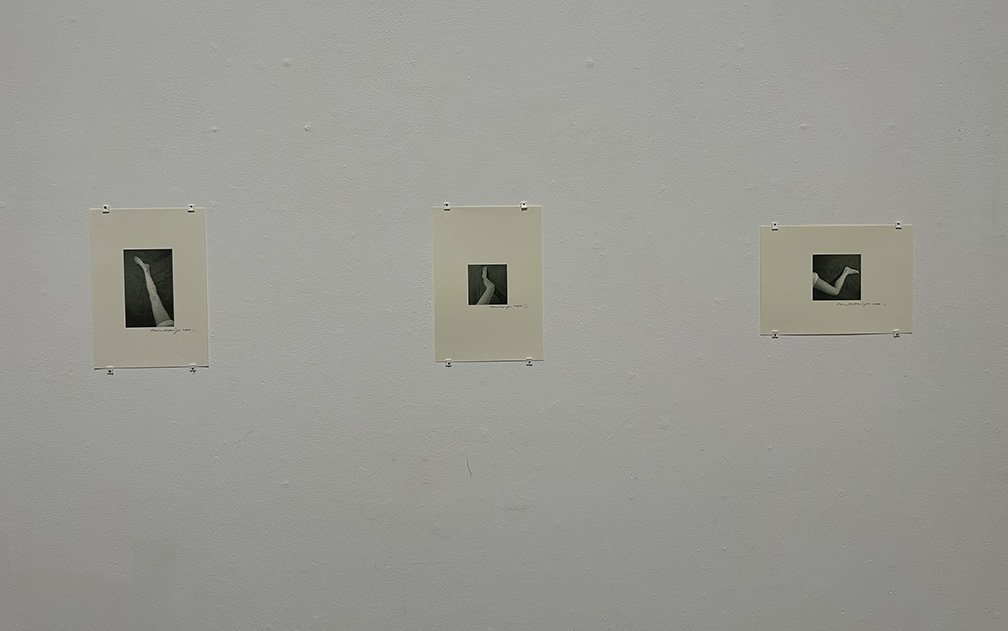
photo sketch No. [number unknown], "portrait of the leg"
2000
refgraph print, Japanese paper
Takahashi Ryutaro Collection
The solo exhibition Trace the Skin (April 4–28, 2000), MOTOMIYA Kaoru’s first exhibition at Mizuma Art Gallery, appears to have consisted entirely of new works from the project Trace the Skin. Along the gallery walls were displayed works such as Leg Stretched to 1.8 Meters and Tongue Stretched to 20 Centimeters, which resembled plastinated anatomical specimens, with cross-sectional slices of body parts such as legs and tongues arranged at regular intervals. Several of these works later entered the Takahashi Ryutaro Collection; however, because they were made using latex, they no longer retain their original form today.
photo sketch No. [number unknown], “portrait of the leg” and photo sketch No. 8, “portrait of the tongue” were listed in the original exhibition checklist as portraits corresponding respectively to Leg Stretched to 1.8 Meters and Tongue Stretched to 20 Centimeters. Notes indicating “self-portrait” also survive, suggesting that the artist photographed her own leg and tongue. The multiple lines drawn at regular intervals across the leg and tongue further suggest a correspondence with the individual cross-sectional slices in the larger works.
The portrait corresponding to Tongue Stretched to 20 Centimeters was re-exhibited in Medicine as Metaphor: Art and Medicine at NTT InterCommunication Center (ICC) (January 18–March 24, 2002), from whose documentation it can be identified as photo sketch No. 8, “portrait of the tongue.” The same documentation also reveals that Leg Stretched to 1.8 Meters and Tongue Stretched to 20 Centimeters belonged to the “trace the skin” series—a title identical to the project name in English, though semantically closer to the Japanese expression. This, in turn, clarifies that these works formed a conceptual pair of “inside” and “outside” with Internal Dress, Internal Quilt, which occupied the center of the gallery and extended its marshmallow net, conceived as the inner wall of the digestive tract, toward the bed and washbasin.
What remains unknown are the catalogue numbers that were presumably assigned to the three surviving photographs corresponding to Leg Stretched to 1.8 Meters.
(Text by NAKAZAWA Hideki)
Supplement I
Two other works, both untitled, were also exhibited in The Trace the Skin. One consisted of latex, a drawer, ID photographs, and a passport; the other of latex, artificial hair, and artificial marble. Although neither directly concerned the skin or the digestive tract, the former clearly addressed identity—the elements that define me as myself—while the latter dealt with the uncertainty of where the boundaries of the self begin and end, appearing both like and unlike oneself. Sugary confections begin as something external to the self, are incorporated through the extended membrane and become part of the self, yet are eventually detached again, like nails and hair, dispersed and returned to otherness.
Come to think of it, the “trace the skin” series also included Nails Stretched to 5 Centimeters and Hair Stretched to 4.2 Meters. Although omitted from their official titles, the photo sketch works were unmistakably self-portraits by the artist. In that sense, this was a perfect solo exhibition.
Supplement II
The inconsistencies in notation are understandable. Up to that point, MOTOMIYA had been known for feminine rabbits and anatomically themed works, but it was with The Trace the Skin project that she truly came into her own as an artist. The Marshmallow Dress (as we called it among ourselves) was a key transitional work. If one focuses on its soft texture and its white, sweet material, it can certainly be seen as a continuation of Rabbit Project. Likewise, if one focuses on the anatomical knowledge embodied in the surface area of the digestive tract, it can also be understood as an extension of that earlier project. Indeed, this may have been the character of floating body, the exhibition at Plus Minus Gallery where these works were shown alongside her recent works of the time.
However, only one month later, at Trace the Skin exhibition at Mizuma Art Gallery, everything changed. The “marshmallow-ness” of the marshmallows was no longer emphasized at all; instead, the artist entrusted the work with questions of her own identity and its uncertainty. The “trace the skin” series, while still drawing on anatomical imagery, can also be understood as an extension of the territory of the self.
In later years, the artist classified her oeuvre into nineteen projects. Yet despite the use of the term “project,” there is no entry entitled Rabbit Project; instead, it was divided into Hairball Machine and Portraits of Animals. A quarter of a century later, although the work has been preserved in excellent condition, the marshmallows no longer retain the softness and whiteness that make marshmallows what they are. Moreover, the anatomical figure concerning the surface area of the digestive tract has since been revised to the much broader estimate of “approximately the area of a tennis court.”
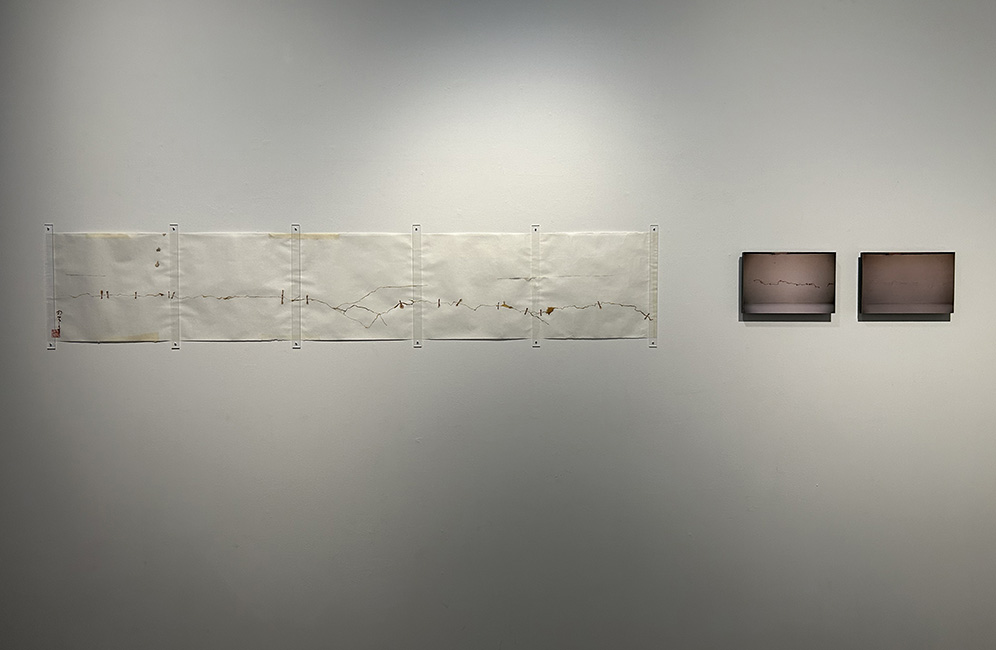
Chambers fine arts gallery, NYC, USA
2003
C-print, Drawing, shoji paper, pigment
Takahashi Ryutaro Collection
Although MOTOMIYA Kaoru produced her work in the form of projects throughout her career, the best known and longest-running among them was Restoration Regeneration, a project focused on repairing damaged things. In January 2001, when she began a residency at ISP [1], then located in Tribeca, New York, she found that the floor of Studio #11 assigned to her was in terrible condition. Thinking, “How can I possibly work in a place like this?”, she conceived the idea of making the repair itself into an artwork—specifically, by applying bandages to the floor and stitching together its wounds. [2] I have heard directly from the artist that this was the origin of Restoration Regeneration. The artist herself, however, identified its starting point slightly earlier, in drawings she made during a residency at Headlands Center for the Arts in California in the autumn of 2000 by placing paper over cracks in the studio wall and taking rubbings from them.
In subsequent years, the project came to make extensive use of kintsugi, the traditional Japanese technique of repairing with gold. Its objects of restoration expanded beyond plates and bowls to include walls, buildings, workshops held in various locations (repairing memories and broken hearts), psychiatric hospitals, and even the shells of living turtles and snails. At the same time, the artist seems to have found beauty in the way cracks in ceramics resemble the branching of trees or the paths of rainwater. This attention to the forms of scars and traces themselves remained consistent throughout the project, beginning with those first drawings in California.
Chambers fine arts gallery, NYC, USA was exhibited in Revolving Door: ISCP <-> Asia, a group exhibition at Chambers Fine Art Gallery in New York. The work consists of photographs documenting a crack in the gallery ceiling before and after its repair using kintsugi, together with a drawing transferred onto Japanese paper from the repaired wall. A drawing made from the wall before its repair may also have existed, but has not been found. [3] The work reveals both the idea of treating the act of repair itself as an artwork and the attitude of appreciating scars (or traces) as objects of contemplation in their own right.
(Text by NAKAZAWA Hideki)
[1] International Studio Program, later renamed ISCP (International Studio and Curatorial Program).
[2] Works such as a patch of the floor at studio #11 were produced and exhibited, and prototypes also survive. Incidentally, the photograph used on the address side of the exhibition postcard for this exhibition was taken on March 30, 2001, during ISP's Open Studio. It shows the artist pointing to an actual scar in the floor while placing beside it a photograph documenting its repair.
[3] In the solo exhibition MOTOMIYA KAORU 2005, held at Mizuma Art Gallery, then located in Nakameguro, from September 20 to October 15, 2005, one drawing and a pair of photographs were exhibited. The drawing and the photographs were listed as separate works sharing the same title. Both later entered the Takahashi Ryutaro Collection. Subsequently, a photographic image showing two drawings and four photographs together came to light. During the present research, two additional photographic works were discovered in Mizuma Art Gallery's storage, but the other drawing has not yet been found.
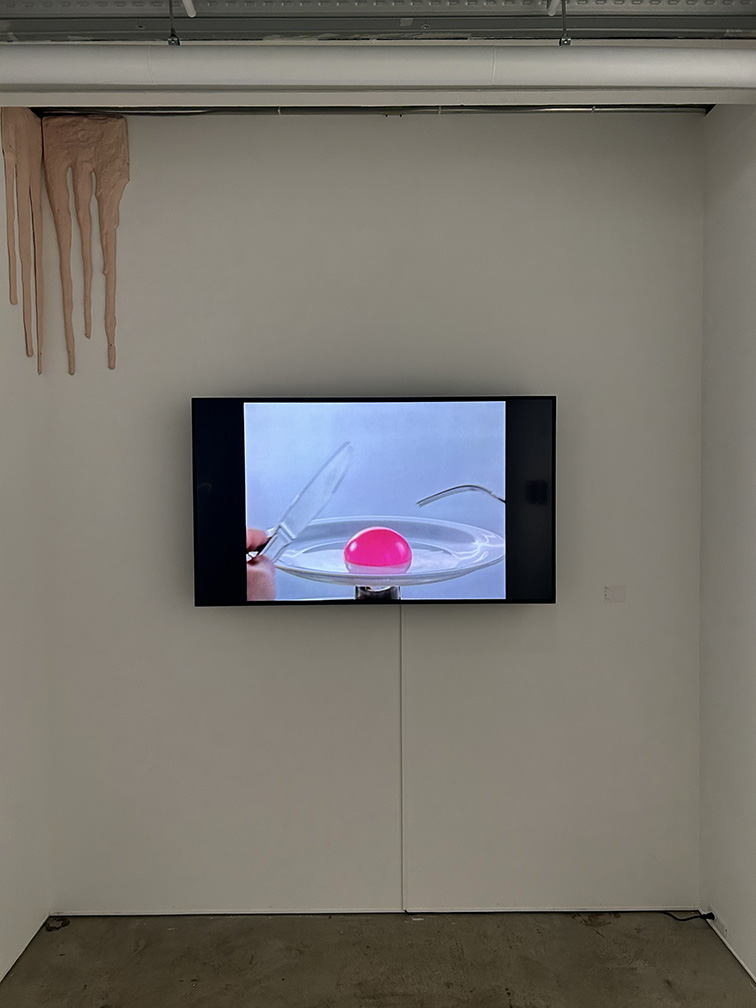
Overflow
2002
Video
2 min 54 sec
A pink, hemispherical object resembling a soft, jiggling jelly is the protagonist of this video. On a plate, it is threatened by a hard metal knife and fork approaching from either side, as if about to be chopped into pieces; then the plate begins to rotate while sweet Canadian maple syrup is poured over it from directly above until it overflows. Music and voice samples by Stock, Hausen & Walkman, then gaining popularity, are used effectively throughout. Sweet, cute, comical, and girlish on the surface, the work also suggests that eating and being eaten entails a one-sided, cruel, and macho form of violent exploitation—an act of chopping and being chopped. In the kitchen, preparations for such acts unfold every day.
The artist appears to have shot and edited the footage that became the basis of this work during her residency at Banff Centre for the Arts, Canada, in 2001, [1] and presented it as the video installation project kitchen 2001. There is also a record indicating that it was screened that same year at Western Front in Vancouver. In the following year, at Medicine as Metaphor: Art and Medicine held at NTT InterCommunication Center (ICC) in Tokyo, the video was projected on a large wall and exhibited as part of the large-scale video installation KITCHEN ver. 2.0, CANON, together with dining table of refusal, version 2.0, eat or die, and everyday objects such as a refrigerator, a table, and a sofa. Thereafter, under the revised English title Canon on the Table, similar installations continued to be exhibited internationally as part of the project Canon on the Table. In 2003, it was exhibited as Canon on the Table (project kitchen 2001) at the International New Media Art Festival Videomedeja in Novi Sad, Serbia and Montenegro, where it received the Audience Award.
Numerous versions and variations of the video exist. Different musical tracks are used, condensed milk is sometimes poured instead of maple syrup, and in some versions the pink object is transformed into spaghetti-like strands and picked up with chopsticks. There are also versions approximately one hour in length, as well as videotapes containing several shorter works arranged in loops. Many appear to have been intended for video installations, but there also exists a 1-hour-37-minute DVD titled Overflow 2003, apparently packaged for distribution.
The version presented continuously in this exhibition is a compact 2-minute-54-second edition, which appears to have been edited in 2002 for standalone screening rather than as part of an installation. Although the image quality is somewhat degraded, perhaps because it was edited through dubbing, the presence of subtitles and its comparatively clear narrative structure made it particularly suitable for this exhibition. Installed high on the adjacent wall is a portion of 0verflow piece (on the wall), which was first incorporated into the video installation in the solo exhibition Canon on the Table at Newhouse Center for Contemporary Art, New York, in 2003.
(Text by NAKAZAWA Hideki)
[1] Numerous Betacam and VHS tapes bearing Banff Centre for the Arts labels survive, dated “May 2001” and titled Overflow (Part 1), Overflow (Part 2), kitchen, Silicone ball & spaghetti, and others.
[2] (Added on June 27, 2026) A video installation based on fragmentary diary entries written by a person with anorexia nervosa, projected diagonally onto a wall painted with speech bubbles.
[3] (Added on June 27, 2026) For this exhibition, the higher frequencies of the audio were attenuated and the overall volume was reduced so as not to interfere with the viewing of the other works.
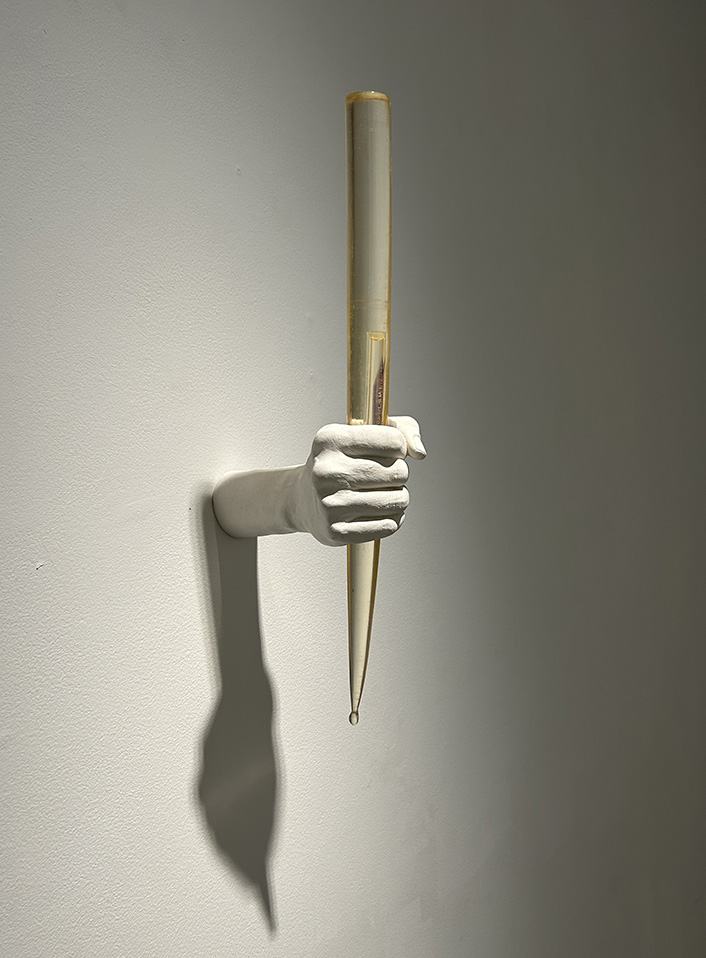
“Hello Scot” Encapsule #12, Clyde River, October 14th 2009
2009
Water from the River Clyde, resin, acrylic, plaster, and paper
In September 2009, MOTOMIYA enrolled in the Master of Fine Art (MFA) program at the Glasgow School of Art in Scotland and rented an apartment in Glasgow to begin a new phase of artistic activity. People around her reportedly said things such as, “You already have more than enough of a professional career—why become a student at this stage? Becoming a teacher would make more sense.” Nevertheless, the title Hello Scot may be read as “Hello, Scotland!”, suggesting her delight at embarking on a new chapter in an unfamiliar place. The tense image of a stark white wrist protruding from the wall while vertically holding an icicle can be regarded as quintessential MOTOMIYA Kaoru.
The reason I believe the title does not mean “Hello, Scottish people!” is that another work from the same period is entitled Hello Clyde. This title appears to address the River Clyde, which runs through central Glasgow, as if saying, “Hello, River Clyde!” It likely draws upon Name of Water, a project that began after the artist collected river water in Vienna, the Czech Republic, and Slovakia during the severe winter of January to March 2005, and later continued in Yokohama. In Yokohama, the water collected in Vienna was transferred into small bottles, whereas the artist wrote on her website that, in this work, “the silhouette of a fish floats within a cylinder that encloses the water.” Once one knows this, one can almost see it. [1]
Hello Scot and Hello Clyde were sent to Mizuma Art Gallery shortly after its relocation to Ichigayatamachi, and Hello Scot was exhibited in the group exhibition November Steps — Susan Philipsz & Gallery Artists (November 4–December 5, 2009). The works were subsequently returned to the United Kingdom, and both were exhibited in the group exhibition Criteria of Beauty at T1+2 Gallery in London.
On the artist's website, which received its final update during her lifetime in 2018, Hello Clyde remained titled Hello Clyde (Japanese title: Hello, River Clyde), whereas Hello Scot had been (re)titled Icicle Swimmingly (Japanese title: Tsurara, Surasura to), adding another layer of mystery. [2] The artist's classification of her oeuvre into nineteen projects is equally enigmatic. Hello Clyde and Hello Scot, both depicting hands holding icicles horizontally or vertically, are the only two works assigned to the project Capsule. Yet a closely related group of works—also made in Glasgow during the same period and likewise featuring hands protruding from walls, though holding capsules instead of icicles, or sometimes nothing at all—was assigned to a different project entitled Encapsulation. Furthermore, this word Encapsulation, appears within the title of the present work itself as “Encapsule #12.”
In 2010, MOTOMIYA suddenly returned to Japan. From then until her death in 2022, she never again traveled abroad, nor did she present any new works publicly. Her website includes a new project in Kanagawa Prefecture entitled Wayfarer’s Stone, marked “2020 (planned).” In fact, she did create several decorative interventions resembling artworks in the garden of her husband's family home after reconciling and remarrying in 2010, but these were never made public. In practical terms, the body of work produced in Glasgow—including the present work exhibited here—constitutes her final artistic output as an artist during her lifetime.
(Text by NAKAZAWA Hideki)
[1] The installation instructions preserved at Mizuma Art Gallery include the note “make the letters visible.” Indeed, one can make out the word “RIVER.”
[2] For this exhibition, the title used when the work was exhibited at Mizuma Art Gallery in 2009 has been adopted as the official title.